

What Is The Economic Principal That Determines The Prices Of Goods And Services?
Chapter three. Demand and Supply
Introduction to Demand and Supply
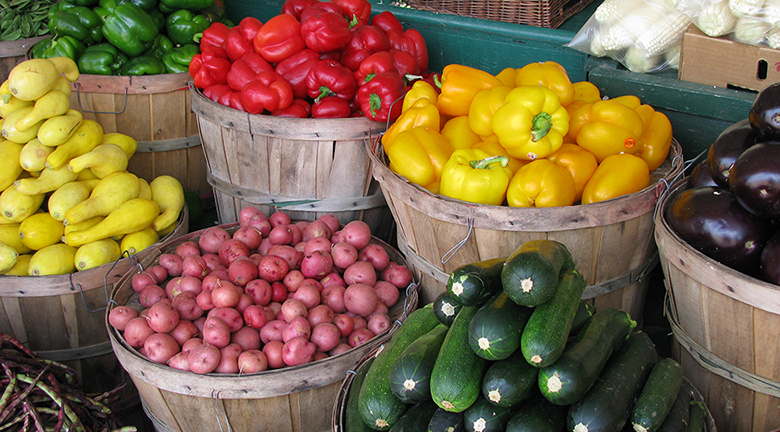
Why Tin We Non Get Plenty of Organic?
Organic food is increasingly popular, not just in the The states, but worldwide. At one fourth dimension, consumers had to go to specialty stores or farmer's markets to notice organic produce. Now it is available in nearly grocery stores. In short, organic is part of the mainstream.
Ever wonder why organic food costs more than than conventional food? Why, say, does an organic Fuji apple tree price $1.99 a pound, while its conventional counterpart costs $1.49 a pound? The aforementioned cost relationship is true for only nigh every organic production on the marketplace. If many organic foods are locally grown, would they not accept less time to go to market and therefore exist cheaper? What are the forces that keep those prices from coming downwards? Turns out those forces have a lot to do with this chapter's topic: need and supply.
Chapter Objectives
Introduction to Demand and Supply
In this chapter, you will learn about:
- Demand, Supply, and Equilibrium in Markets for Goods and Services
- Shifts in Demand and Supply for Goods and Services
- Changes in Equilibrium Price and Quantity: The Four-Step Process
- Price Ceilings and Toll Floors
An auction bidder pays thousands of dollars for a clothes Whitney Houston wore. A collector spends a small-scale fortune for a few drawings past John Lennon. People unremarkably react to purchases like these in two ways: their jaw drops considering they think these are high prices to pay for such goods or they think these are rare, desirable items and the amount paid seems right.
Visit this website to read a list of bizarre items that take been purchased for their ties to celebrities. These examples represent an interesting facet of demand and supply.

When economists talk most prices, they are less interested in making judgments than in gaining a practical understanding of what determines prices and why prices change. Consider a price most of us debate with weekly: that of a gallon of gas. Why was the average cost of gasoline in the U.s. $3.71 per gallon in June 2014? Why did the price for gasoline fall sharply to $ii.07 per gallon by Jan 2015? To explain these price movements, economists focus on the determinants of what gasoline buyers are willing to pay and what gasoline sellers are willing to accept.
Equally information technology turns out, the price of gasoline in June of any given twelvemonth is nearly ever higher than the cost in Jan of that same year; over recent decades, gasoline prices in midsummer take averaged almost 10 cents per gallon more than than their midwinter depression. The likely reason is that people drive more than in the summer, and are besides willing to pay more for gas, but that does not explain how steeply gas prices vicious. Other factors were at piece of work during those six months, such as increases in supply and decreases in the need for crude oil.
This chapter introduces the economic model of need and supply—i of the most powerful models in all of economics. The word hither begins by examining how need and supply determine the cost and the quantity sold in markets for appurtenances and services, and how changes in demand and supply lead to changes in prices and quantities.

What Is The Economic Principal That Determines The Prices Of Goods And Services?,
Source: https://opentextbc.ca/principlesofeconomics/chapter/introduction-to-demand-and-supply/
Posted by: paylorsarlizies70.blogspot.com
0 Response to "What Is The Economic Principal That Determines The Prices Of Goods And Services?"
Post a Comment